
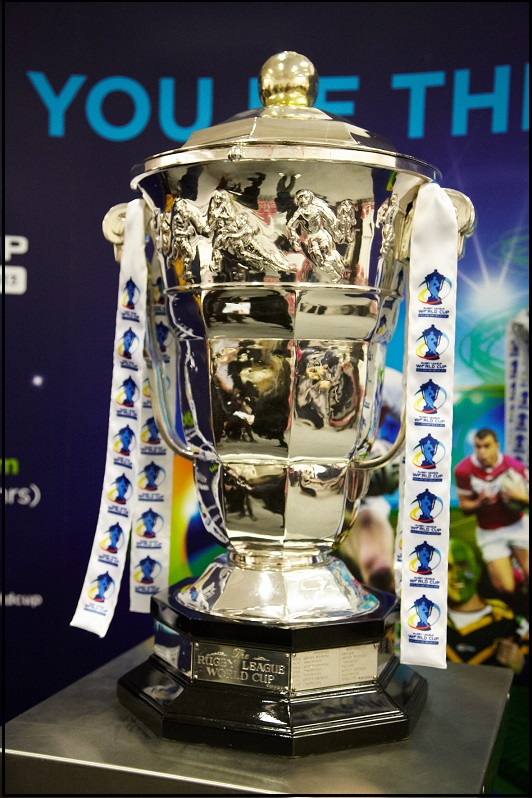
Aussies retain the Rugby League World Cup – but they’re pushed to the limit
Rugby League World Cup Final – 2nd December, 2017 – Suncorp Stadium, Brisbane
Australia 6, England 0. Scorers – Try: Cordner; Goals: Smith. Attendance: 40,033
Tough. Attritional. Bruising – and very close. Australia retained the Rugby League World Cup the hard way, finally edging past a brave and spirited England in Brisbane Last night. The closeness of the match was emphasised by the 6-0 scoreline, and anyone expecting the Aussie’s to cut loose with a try-fest would have been sorely disappointed.
Sometimes in sport, the familiarity and confidence that comes with winning gives you an edge that puts you in that place, that zone, that your opponent’s find hard to reach.
It’s as if the chasing team is trying to build a ladder to reach you, where the rungs are made from your own successes and your own self-belief – but if you can’t find enough raw material for its construction, you can’t reach the place you’re striving for. And that’s perhaps where this England team sit, after so many years of Australian domination.
However, this match should really change England’s mindset and level of confidence now. It was telling to hear the St Helens Coach, the Aussie Justin Holbrook, comment on the BBC, post-match: “If they played in two weeks’ time you’d half expect England to possibly win that game, that’s why England v Australia games are really good now – and you want them more often”.
The match started in cautious and cagey fashion, both teams kicking for field position and territory, an area where Australia are traditionally better than all their opponents. England needed to be precise and unforgiving right from the start, delivering a full, eighty-minute performance – nothing less.
Early on, a concern for England was the space they were allowing Aussie half back Cooper Cronk for his kicking – he was finding gaps at will, with some very eager Australians following up each time. England’s kicking was higher and longer – designed to give more time for the kick-chase.
The game began to open up. Australian pressure was growing. They would go on to complete 23 of 25 sets before half-time. The physicality was unnerving. It may be argued that Australia luckily escaped censure for some high tackles. Whatever they were, they certainly made this observer wince. You could say there were more clothes lines on the field than you’d see in a Robert Dyas January sale.
Ironically, England’s half back Luke Gale was then penalised for exactly this reason, which led to a run of four straight sets for the Aussies, after a decent bout of handbags which no doubt made both sides feel better.
Pressure was mounting and the Aussie kicks were raining down on England’s try line. On 14 minutes, full back Gareth Widdop sent a huge dropout 40 metres downfield which came back with interest, in the form of a storming run by prop David Klemmer. A couple of tackles later, via some fluid passing from skipper Cameron Smith, Cronk, and half back Michael Morgan, their hulking second-row Boyd Cordner crashed over for the try. The resulting goal-kick was thrashed over contemptuously by Smith and the Australians bristled with the confidence gained from drawing first blood – Ominous.
England were battling hard. Winger Jermaine McGillivary – who’d been making countless metres all tournament – looked dangerous whenever he got the ball, although he found it hard to escape Australian clutches. Their defence was looking like the perfect amalgam of aggression and solidity.
England’s Widdop was elusive and smart, but, like McGillvary, was largely being kept in check by the opposition. Luke Gale’s boot was showing good power. England were ticking over, but finding it hard to emerge from the smothering blanket of Australian pressure and organisation.
But there were chances. On 19 minutes winger Ryan Hall found himself bearing down on the Aussie line in their right-hand corner, following a tap-penalty. He was crowded out by two defenders but managed to offload backwards to centre John Bateman on the touchline. But almost as soon as Bateman got his hands on the ball, he was hit hard by Australian second-rower Matt Gillett, who made it abundantly clear to Mr Bateman that he was going no further, as he bundled him into touch for an Australian scrum.
Three minutes later, McGillvary bombed down the right wing after a neat pass from centre Kallum Watkins. Ten metres out, he stepped neatly between Australia’s full-back Billy Slater and Morgan. Sadly, for England, whilst Morgan remained on the deck nursing his twisted blood, Slater recovered well enough to bring McGillivary down – chance gone.
Five minutes before half-time, England were awarded a penalty for holding down in the tackle. A potentially big moment, as they were on their last play. With six more now available, they decided to tap and go, perhaps sensing the Australians were running out of gas? It had certainly been a draining, bruising half of rugby.
As passes were exchanged, with England moving smartly over the 10-metre line, hooker James Roby found Gale, but just when composure and precision were needed, Gale’s pass found thin air, the ball bouncing between two England players and the opportunity was butchered.
So, 6-0 Australia at half-time. England surely believed they were still very much in this. But they had to execute better, and show greater patience. They were, however, working incredibly hard all over the pitch. Crucially though, the Kangaroos’ passing looked crisper and more accurate, with better support runs than their opposition.
Eight minutes into the second-half, Australia thought they’d scored a second try. A cross-field kick from England’s Luke Gale was pouched on his own goal line by Aussie centre Josh Dugan, who zoomed downfield like a man possessed, making vital ground after a run of over 40 metres. Two tackles later, Matt Gillett attacked the England 10-metre line at pace.
From the ensuing tackle, substitute Jordan McLean put Michael Morgan in for a try. Or was it? Referee Gerard Sutton checked with the TMO, who adjudged Cameron Smith to have obstructed England’s second-row Elliott Whitehead just prior to the pass to Morgan – no try. Huge relief for England. The evidence was conclusive, with no real argument from Australia.
On 64 minutes, England put together a fine passing movement, starting on their own 30-metre line. The ball passes swiftly between several pairs of hands and Kallum Watkins finds himself in a great position, 50 metres out, clear turf in front of him, afterburners on…what a chance. Watkins skins Aussie winger Valentine Holmes, and looks like he’s done the same to Josh Dugan, but he dives headlong, stretching every millimetre, to brilliantly ankle-tap Watkins. Dugan makes just enough contact to unbalance the flying centre, who can’t maintain his balance and eventually topples – a massive moment in the game.
The game now resembles the final round of a heavyweight title fight where both boxers have pretty much punched themselves out. The pace has slackened, and it looks like the intensity of the match has caught up with both sides. The clock though, of course, mightily favours the Aussies.
With barely five minutes to go, it’s an England penalty. They make decent progress and get to 30 metres out – but it comes to nothing as replacement Tom Burgess carries the ball into fierce contact with Cordner and replacement Wade Graham, who do a brilliant impression of a set of buffers, with Burgess playing the train.
The impact knocks the ball flying from Burgess’s grasp and it’s ruled a knock-on. That’s England’s eleventh error of the match – too many to get away with when you’re playing Australia.
That proved to be last orders in the last chance saloon for England, and the hooter sounded to confirm Australia as World Champions for the 11th time. What an effort by England. The final score of 6-0 confirming the massive scare they gave Australia.
Relief as much as celebration for the Aussies? Quite probably. The closeness of the match will be the frustration for England. They left nothing out there but it was still not quite enough. Narrow defeats usually come down to fine margins. I’d say the greater composure the Australians showed at key moments was decisive – England looked slightly rushed when the coolest of heads were required, and their error-count was ultimately too high. But it’s hard to criticise such an outstanding overall effort.
This was a final of such ferocious intensity that England’s Australian Head Coach Wayne Bennett compared it to Australia’s renowned State of Origin series. “The intensity of it, the effort of both teams, they were exhausted – and still found something”, he said.
“They probably had a bit better ball control than we did, we had to do more defending. We probably just didn’t execute a couple of things we should have. That’s been our Achilles heel. It’s so much better. It’s not where it wants to be just yet. It’s a pity there has to be a loser on a night like tonight. The scoreboard says you lose but what did we lose? The effort, the intensity, trying as hard as they did”.
“Both teams had good shape, both had lots of options. That’s what makes sport great. Somebody’s got to win, somebody’s got to lose.”
It’s a delicate time for England, with Bennett’s contract now up, and no new deal or agreement with the Rugby Football League in place as yet.
Bennett’s opposite number Mal Meninga said the game reminded him “of the old days. Six-blot. You’ve got to fight hard for everything you get”. Meninga praised Bennett and his team, aware of Bennett’s possible departure.
“I spoke to him (Bennett) after the game and they’re improving all the time,” said Meninga. “It’s up to him, but they made huge strides, I thought. It’s good for the international game, isn’t it? They look like and they play like a Wayne Bennett side. They control the footy really well and they get to the kick and they try to play the field position game and keep on turning up for each other defensively. He’s got that hard edge and commitment around defence. There’s not many chinks in their armour. We found one tonight and that was all.”
Before this game, Australia had conceded only 16 points in 5 games in this tournament, emphasising the size of the challenge for England. Australia beat England 18-4 in the first group match of the tournament, and in personnel, England were sadly missing their captain Sean O’Laughlin through injury. The Bookmakers had England at 7-1 before kick-off – it’s fair to say they weren’t fancied, but this performance will have changed a few perceptions of England for sure.
Australia’s famed “Holy Trinity” of Cronk, Slater and Smith all played their part in the win. Legends all – and testament to the enduring quality of Australian Rugby League. Over 300 games together (and with a suitable adornment of trophies) at Club, State of Origin and International level – incredible.
What a match, what a contest and what a terrific advert for Rugby League. It was so close, but when you ultimately lose a game for the biggest prize, the margin probably seems irrelevant. To Australia the spoils – to England, only tears.
England: G Widdop; J McGillvary, K Watkins, J Bateman, R Hall; K Brown, L Gale; C Hill, J Roby, J Graham, B Currie, E Whitehead, S Burgess (capt).
Replacements: A Walmsley, T Burgess, C Heighington, J Lomax.
Australia: B Slater; D Gagai, W Chambers, J Dugan, V Holmes; M Morgan, C Cronk; A Woods, C Smith, D Klemmer, B Cordner, M Gillett, J McGuire.
Replacements: W Graham, J McLean, R Campbell-Gillard, T Frizell.
Man of the match: Boyd Cordner, Australia.
Man of the tournament: Billy Slater, Australia
By Chris Tribe
3rd December 2017
Copyright © 2017 Chris Tribe. All Rights Reserved.
Photo credit: Copyright © Leeds Library and information Service/Rugby League World Cup Trophy Tour’s Event at Leeds Central Library
Licensed under the Creative Commons Attribution 2.0 Generic license.

 Chris Tribe Sportswriting