
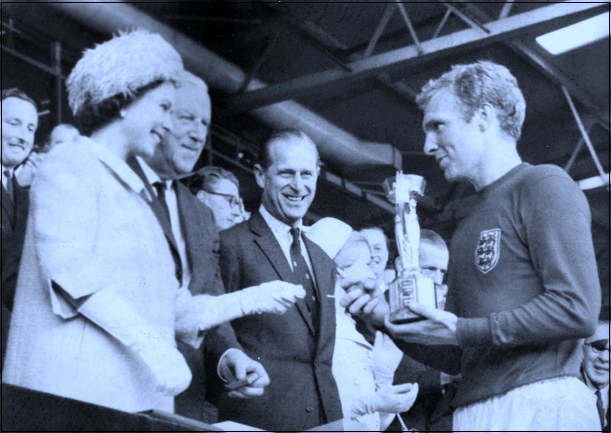
Lack of a knighthood for Bobby Moore is a disgraceful error that can never truly be put right
I think the knighthoods announced yesterday for Andy Murray and Mo Farah are largely welcome, and obviously in keeping with how the honours system has worked in recent years, at least in the world of sport.
Murray and Farah are of course absolute superstars in their respective fields. Murray is unquestionably the best British tennis player ever, and Farah our greatest ever distance runner. If you bundle up Olympic gold medals and majors together, that’s nine between them. Fantastic.
One could argue (and I do), that these honours are somewhat premature, based on the fact Murray isn’t even 30 yet and Farah only 33 – and both are very much still active in their sports. But that’s the fashion these days, gongs bestowed very swiftly after major achievements.
It’s almost as if successive governments in recent years are rushing to be seen in reflective glory behind our honoured sports stars, trying to prove they were majorly responsible for their successes, that their achievements were part of a wonderful political administration that in itself was high on achievement, and well worth celebrating…but surely not?
Anyhow, here’s the thing that really bugs me here. Bobby Moore – England’s greatest ever captain, World Cup winner, 108 England caps, chosen in the FIFA World Cup all-time team in 1994 and the World Team of the 20th Century in 1998. Generally considered to be one of the world’s greatest ever defenders – the fact that he was selected for the FIFA World Cup all-time team alongside Franz Beckenbauer says it all. Certainly, no other British defender comes close to Bobby. So why was he never knighted?
I know it’s an old gripe raised previously by many, but each year, when the latest sporting stars are honoured, it always accentuates this curious, unfathomable anomaly. The government say knighthoods cannot be awarded posthumously. You can petition them to ask if this ruling could be changed in the future, but you cannot petition to ask for specific individuals to be honoured. A proposed petition to the Government in July of this year for Moore to be knighted was rejected, because “it’s about honours or appointments”.
Amazing how those in power so frequently dismiss things that matter so much to so many people, or consider them to be irrelevant, should they fall foul of “regulations” that render the subject a closed book, off-limits, nothing to do with the public and what they may think.
But even if a knighthood in this case were ever to be awarded posthumously, would it actually feel like a consolation, that could never replace the pleasure given to Bobby and his family, had he have received this when he was alive?
Yes, Moore did receive an OBE in 1967, and no doubt he felt honoured to do so. But to perhaps put that in perspective – and with no disrespect intended – John Motson, Jimmy Hill, Des Lynam and Garth Crooks all have one too.
Craig Brown, former Scotland manager, has the higher award of a CBE, as does former Chelsea defender Paul Elliott. One could scratch their head until their fingers bled and they were completely bald before making sense of that, compared to Moore’s OBE.
Moore was also criminally underused by football in general, after he retired from playing. One of the most valid views on this came from his former West Ham teammate Harry Redknapp. He was interviewed by Chris Scull for the excellent KUMB.com website in February 2013, where Chris asked Redknapp if he thought those running the game had let Moore down in recent years. Redknapp replied: “Absolutely, yes I do. The people at West Ham, people at England. To see him commentating, doing the radio…I went to Grimsby one night with West Ham and he’s doing Radio London or whatever it was, eating a bag of fish and chips on a freezing cold night probably getting £100. What a waste, he should have been walking in there as ambassador for West Ham, as the people of Grimsby would have loved to have seen him there that night as he should have been. It was a waste and like lots of things in life, people don’t realise what they’ve got until it’s gone”.
To think Moore also once wrote a column for the Sunday Sport just underlines this sad scenario. A massive talent, full of experience and knowledge, never given a decent opportunity to share that with those who would have benefitted most, the future footballers – and not just defenders – of England.
There are many great quotes about Bobby of course. “Bobby Moore was the best defender in the history of the game”, said Franz Beckenbauer. “Moore was the best defender I have ever seen”, said Sir Alex Ferguson. “There should be a law against him. He knows what’s happening 20 minutes before everyone else” – Jock Stein. The legend that is Pelé, who like Moore was so symbolic of the golden eras of football in the sixties and seventies, said at the time of Moore’s death in 1993: “He was my friend as well as the greatest defender I ever played against. The world has lost one of its greatest football players and an honourable gentleman”.
But the final word on Bobby Moore’s career and influence should rest with his World Cup winning manager, Sir Alf Ramsey – putting aside the irony of Alf being knighted whilst Bobby never was. Ramsey surely summed up the feelings of millions, when he said:”My captain, my leader, my right-hand man. He was the spirit and the heartbeat of the team. A cool, calculating footballer I could trust with my life. He was the supreme professional, the best I ever worked with. Without him, England would never have won the World Cup.”
Arise, Sir Bobby.
By Chris Tribe
31st December 2016
Copyright © 2016 Chris Tribe. All Rights Reserved.
Photo credit: National Media Museum @ Flickr Commons
Extract from Harry Redknapp interview at KUMB.com by kind permission.Link to full article: http://www.kumb.com/article.php?id=3192

 Chris Tribe Sportswriting