
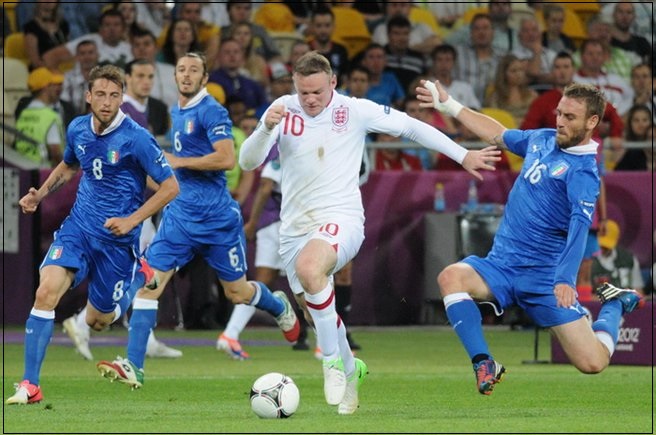
Uncertain England future for the nations record goalscorer
Let’s start with some nostalgia. Saturday 19th October 2002. Whatever your Club persuasion, who wasn’t transfixed when a raw 16 year old curled one into the top corner against Arsenal, leaving David Seaman’s ponytail flapping in the wind, as the England goalkeeper had no answer to this brilliant effort. Clive Tyldesley’s commentary: “Remember the name…Wayne Rooney”!
And so a star was born, announcing his arrival in the most spectacular way. Rooney is probably the most discussed thread through England’s tapestry of travails of the last 13 years of hurt, since he became England’s youngest debutant at 17 versus Australia in 2003.
Then there was Euro 2014. Wow. Rooney’s impact was simply sensational – four goals in four games, terrorising defences and wreaking havoc. He was a match winner who looked like he was playing for fun. The fearlessness of youth personified. The boy in a man’s body – stocky, strong, powerful. Then, disaster – a broken metatarsal. Rooney was out of the tournament, and with it went our best player and our inspiration.
Successive tournaments came and went, with Rooney (and England) never reaching those heights again. Hard to believe that barring something miraculous in Russia 2018, Rooney’s best ever tournament performance would be that of an 18 year old.
Club fortunes? This is where Rooney’s achievements are undeniably fantastic: 14 major honours won at Manchester United, including 5 Premier League titles and a Champions League. Remember his Champions League debut against Fenerbache? September 2004 and Rooney hit a hat-trick of the highest quality, two right foot finishes of power and precision and a sweetly struck free-kick. Nerveless. The man-boy strikes again.
To date, Rooney is 3 goals away from becoming United’s all-time record goalscorer. And for a Club as huge, symbolic and important as Manchester United, that is quite something. Only special players dislodge legends such as Sir Bobby Charlton in any all-time list. Rooney also sits second in the all-time Premier League goalscoring records. Not too shabby.
A stellar club career, without a doubt. For England, it’s been a far tougher ride, with plenty of criticism, concern and comment along the way. It’s as if Rooney is the lightning conductor for all England opinions – more often than not, the first person mentioned when they share their views on the state of our national team – more often than not, sadly, when it’s to vent disappointment. But why? We can’t blame Rooney for all the failings of England. That would be ridiculously unfair on a true patriot, who clearly feels the honour of playing for his Country.
My personal theory is that back in 2004, England fans saw a glimpse of something so exciting and so promising when Rooney emerged. He gave us hope – maybe, just maybe, we had a genuine star in the making who could push England to glory. And for a couple of years, we kept believing. The England squad at this time was the so-called “Golden generation” of players – Rooney had the likes of Beckham, Gerrard, Scholes, Owen, Ferdinand, Cole and Lampard for company.
But success remained as elusive as ever for England, the Euro’s and World Cups passing swiftly by, with increasing disappointment and disillusionment. England flattered to deceive. Impressive qualifying campaigns usually followed by heartbreak in the knock-out stages, often in penalty shoot-outs…England fans’ least-favourite form of torture.
Rooney is the last player of that generation still playing for England, the last player to be saddled with so much hope and expectation, and remember we are going back a long time now. Does he get disproportionate criticism – even subconsciously – because of that?
In recent times Rooney’s been benched by both Club and Country, which undoubtedly must hurt a proud professional. But in each case it’s hardly been a surprise, based on his diminishing impact with the respective teams – plus of course, the quality (and youth?) of alternative players now available.
It’s the same situation with England. Caretaker manager Gareth Southgate dropped Rooney for the World Cup qualifier in Slovenia last month. This was significant, as the press conference that delivered the news confirmed. Players get dropped all the time of course, but when it’s Rooney, still England captain, it’s big – and the great Rooney debate gathers pace once again.
But for me it’s relatively simple. Rooney has long since ceased to be the young tyro who played as a centre forward and did what his instincts told him. They were fabulous days for him, Everton, Manchester United – and of course, England. So if he is to continue playing, another role has to be found – number 10? Centre midfield? Deep-lying quarterback?
Despite a bright start to Manchester United’s season, they have struggles in recent weeks and Jose Mourinho has turned to other players to try to get his side back on track. The ongoing debate over Rooney’s best position doesn’t ever seem to go away, does it? And therein lies the problem for Wayne Rooney, 2016 vintage.
Age catches up with everyone eventually. Many observers make the point about Rooney looking heavier and taking longer to get back to peak sharpness after each injury lay-off. When David Beckham was in the twilight of his own England career, he seemed to slow down the pace of the game, not something that suited England every time. Possession of course is vital, but so is maintaining momentum, particularly if a promising move is unfolding. Is Rooney repeating the same frustrations we saw with Beckham?
Euro 16 was a horrible disappointment for England. Anyone remembering the Iceland game probably still shudders at the memory. Unfortunately for Rooney it was another England failure to be associated with. At 31, I wonder how many more chances he will be given to put that right.
By Chris Tribe
15th November 2016
Photo credit: Илья Хохлов/Wikimedia Commons
Copyright © 2016 Chris Tribe. All Rights Reserved.

 Chris Tribe Sportswriting